

People Change.
Records Can Too.
Pardon Project Steering Committee
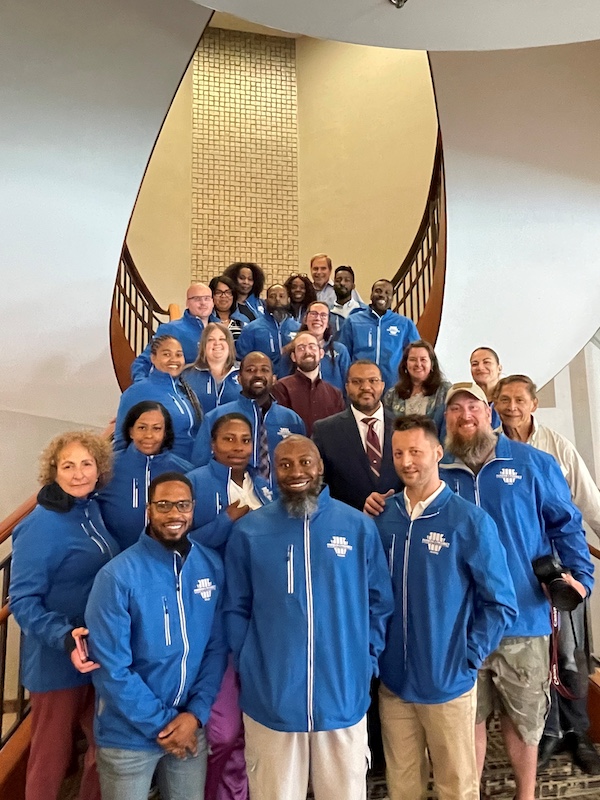
PPSC Leadership Summit, Harrisburg July 2024
“Those who are closest to the pain should be closest to the power.… When people take their pain and channel it into purpose and action, that is how we create positive change and make our system more just.”
~ Lt. Gov. Austin Davis, December 15, 2023, announcing the new law that will make automatic the expungement of pardoned crimes
The PPSC is eager to expand its advocacy, its members, and its reach across Pennsylvania. If you have lived experience in the PA criminal justice system and want to help, contact us at ppsc@papardonproject.org.
If you are interested in joining the Pardon Project Steering Committee (PPSC) or attending one of our meetings, please write us at PPSC@papardonproject.org. We have LOTS to do this year and YOU can help!
The Pardon Project Steering Committee (PPSC) was created in 2018 to ensure Philadelphia Lawyers for Social Equity (PLSE) always remained attentive and responsive to the communities it was formed to serve – those hardest-hit by the stigma of criminal record histories. Its members all had lived experience in the criminal justice systems. Most were clients for whom PLSE had successfully filed expungement petitions; some were clients whom PLSE was helping apply for a pardon; and all were people whose past was holding them and their families back from achieving their potential. In just five years, the PPSC has become a powerful voice for change.
Today (as the reports below demonstrate), the Steering Committee is a statewide organization with a mission of educating, involving and organizing communities impacted by the stigma of criminal records, helping Pardon Projects form in more counties, and engaging and mobilizing Elected Officials in the work of restorative justice. The Steering Committee meets every other month for 90 minutes via zoom. The PPSC now has members in Allegheny, Berks, Bucks, Cambria, Centre, Crawford, Cumberland, Dauphin, Erie, Lackawanna, Lancaster, Lehigh, Philadelphia, Schuylkill, Somerset, Washington, Westmoreland and York Counties. Its Executive Committee includes:
- Zachary Keisling, Pardon Fellow and Chair (Cumberland) (past pardon applicant)
- Anna Joyner, Vice Chair – Outreach and Secretary (Westmoreland)
- Angel Fox, Vice Chair – Advocacy (Dauphin)
- Danea Langston-Banks, Pardon Fellow (Philadelphia) (pardon received)
- Paula Budnick (Montgomery) (pardon received))
- Shuja Moore, Pardon Fellow and Producer/Director of Pardon Me (Philadelphia)
- Tobey Oxholm, Treasurer and Chair, Pennsylvania Pardon Project (Wayne)
- Bishop Michelle Anne Simmons, Chair Emerita
- Akeem Simms, Immediate Past Chair
2025
It is both exciting and sad to begin this year’s summary by welcoming our new Officers – pardon recipient Anna Morcheid (Westmoreland County), Secretary and Vice Chair (Communications) and Angel Fox (Dauphin County), Vice Chair (Advocacy), and by thanking those who have been in our leadership over the past years and now stepped away: Malik Hayes (Lehigh County), who had been an invaluable connection to workforce development programs: Jeremy Oester ( County), whose connections were to community action agencies and whose talents included social media; Mary Hoskins (Lancaster County), who created a new model of service delivery built upon communities of faith; Evan Figueroa-Vargas (Philadelphia County), who has been a leader since the start of the PPSC in 2018 and whose story is such a compelling part of the film Pardon Me and, last but SO not least, Akeem Sims (Philadelphia County), whose service as our Chair and principal spokesperson was truly exceptional, and whose new career path enabled by the pardon he received continues to provide a beacon of home to all. Thank you all sincerely.
One of our goals from 2024 was to increase our presence on social media. In our first step, we started using Facebook to reach new members and to make sure people were aware of happenings that were important to individuals and families suffering because of their past involvement with the criminal justice system. We made numerous postings over the course of the year and our page was viewed over 1,700 times! Please visit our page, follow us, contribute updates from your county via ppsc@papardonproject.org, and use it to spread the good news about pardons!
In April, we released the Discussion Guide for the film Pardon Me. It was a labor of love from Professors Heather Hope Kuruvilla and Dra. Leslie C. Sotomayor II and is an exceptionally easy-to-use resource for anyone who wants to begin a conversation about pardons and the urgent need for them. Click here to obtain a license to see and use the award-winning film.
In June, after many years of development, the Board of Pardons went live with its new online clemency application. The PPSC was first in the state to offer a program and video that teaches people how to use the new system and we created a flyer listing “ten tips” to success. We also hosted another “Town Hall” with a variety of speakers talking about How to Prepare for YOUR Public Pardon Hearing.
We have known for some time that the six-year term of Dr. John Williams as the medical expert on the Board of Pardons was going to expire in November. In September, we interviewed Dr. David DeMatteo and we were the first organization in the state to recommend him as the next person to be appointed as the medical expert on the Board of Pardons. Eventually 25 other organizations joined us in urging his appointment. The year ended with the position officially vacant, leaving us hopeful that Dr. DeMatteo would receive the Governor’s blessing early in 2026.
In October, we were invited to attend the Fairness in Screening Conference in Philadelphia that was presented by Community Legal Services and PolicyLink. Three of our leaders attended the two-day conference, hearing from and networking with leaders from around the country, and learning about how our work with pardons fits into the national criminal justice reform effort.
The PPSC also partnered with State Senator Rosemary Brown, State Representative Tarah Probst, Metamorphosis Women’s Empowerment Center, and the Monroe County Bar Association to host two screenings of Pardon Me and then the first community pardons clinic of the new Pardon Project of Monroe County. Over 20 people with convictions in their past attended and left with a whole new sense of pride in their accomplishments and hope for their futures, as well as a Pardon Coach to help them apply.
As we do every year, we held our awards ceremony in November. This year, we presented “The Rev” Excellence in Advocacy Award to State Senator Camera Bartolotta who not only was key to the formation and growth of the Pardon Project of Washington County (one of our first and most successful Pardon Projects) but has an incredibly impressive resume of leadership in the area of restorative justice. Our second recipient was our own Paula Budnick, whose award recognized her as an “INDEFATIGABLE VOLUNTEER for always leaping to do whatever, whenever, wherever, in selfless service of her vision for a more just and inclusive society.” It really was our honor to honor these two remarkable people.
The year ended with us participating in the statewide Task Force on Expediting Pardons. It was created when the Lt. Governor invited the Pennsylvania Pardon Project to submit recommendations for how to improve the system. Developed over the next six weeks, those Recommendations provided eight pages of immediate steps that the Board could take by itself to reform its procedures. Our fingers are tightly crossed that the LG and the Board as a whole take our Recommendations seriously and implement as many as possible.
Alas, we never did have the opportunity to meet with now not-so-new Attorney General David Sunday, but we are hopeful to have that opportunity in 2026. The year promises to be filled with opportunities to organize and lobby for much needed changes in the pardons system, so be sure to contact us at ppsc@papardonproject.org give us your email address so we can add you to our statewide list of supporters!
2024
It has become clear that the film Pardon Me, directed and produced by our member Shuja Moore, is going to be not just a pathway but a highway to hope and change in our society.
In January, the Greater Philadelphia Leadership Exchange (an initiative of The Economy League) held a screening that was attended by leaders from many sectors – private business, foundations, non-profits, City council, unions and academia. After the film, Shuja joined Julie Wertheimer, Project Director of Mental Health and Justice Partnerships at The Pew Charitable Trusts, and Jeff Brown, founder of Browns Super Stores, in discussing how to make pardons become understood as community investment and workforce development issues that benefit society as a whole.
The year also kicked off with a hugely successful community record-clearing clinic in Lancaster hosted by State Rep. Ismail Smith-Wade-El. 34 people registered for the event; over 100 showed up; and after the film was shown, the event turned into a tent revival, with attendees sharing their experiences and their joy at discovering that there was a way to finally obtain a release from their past. “Rep. Izzy” is now not only sponsoring monthly clinics, but is spreading the good news about pardons to other State Reps. Kudos to PPSC member (and Pardon Project of Lancaster County Co-Director) Mary Hoskins for imagining and creating this new, wonderfully effective outreach model.
Most recently, Shuja was invited to Harrisburg to present his film to the Black Legislative Caucus and lead a panel discussion about second chances. And in Dauphin County, PPSC member Zach Keasling trained State Rep. Justin Fleming and his staff on pardons, and is working with State Rep. Patty Kim and her staff to help make pardons more accessible in their districts.
Meanwhile, in Erie, PPSC member and Pardon Fellow Antonio Howard is blazing amazing pathways. At Law Day in May, the Erie Bar Association presented him with the Liberty Bell Award, for “community service that strengthens the American system of freedom under law.” He’s also been appointed a member of the Governor’s Advisory Commission on African American Affairs. In true Antonio style, at his first meeting, he asked, “What is the difference between pardons and the substance of Juneteenth?” Let THAT question marinate in ALL of our heads and be on our lips wherever we go!
During the first six months of this year, the PPSC continued its letterwriting campaign that calls on the Governor to make signing pardons a priority and added a second, requesting funding in the state’s FY25 budget to help each pardon project around the state hire a coordinator. Its members continued attending criminal records clinics being held across the state, and participated in several statewide conferences, including the PA Workforce Development Association. And its members also helped translate key pardon documents into Spanish, and conducted a Do-It-Yourself pardon training in Spanish, putting them on the web.
In May, at its annual meeting in Harrisburg, the Pennsylvania Bar Association awarded its prestigious Louis Goffman Award to the Pardon Project. The Award was accepted by our Secretary, Paula Budnick, who issued a “call to action” to all the attorneys in the room: “The prospect of a second chance IS attainable….YOU can make all the difference: helping someone submit their application can change the trajectory of their future.”
In July, a very successful Leadership Summit held in Harrisburg allowed leaders from Erie to Bucks, Somerset to Lehigh meet each other in person for the very first time. The energy and synergies were amazing, and the new Team left having created three new subcommittees: (1) Operations – to make sure all Pardon Projects in the state were using best practices, (2) Outreach – to strive to bring the message of pardons to impacted communities everywhere in the state and to organize them into a unified voice for change, and (3) Making All Pardons a Priority (MAPP) – to advocate for systemic reforms that will eliminate the backlog and result in pardons being recommended and signed far, far, far faster than they are today.
Over the next four months, the PPSC worked hard to develop a gameplan for expanding its outreach and organizing, this time relying on our natural allies who are already serving low-income communities: workforce development organizations, recovery communities, veterans, community action agencies, reentry communities, legal aid, and others. Now that we have staff, we look forward to making more connections, faster.
And finally, in November, we held our annual awards ceremony. This year, we presented “the Rev. Michelle Excellence in Advocacy Award” to State Senator Lisa Baker who, as Chair of the Judiciary Committee, was instrumental in writing into law the automatic expungement of pardoned crimes (which became effective this past June), and to Zach Keasling, the Pardon Fellow from Cumberland County who has been so instrumental in establishing pardon projects in several counties and in leading the PPSC.
Looking ahead, we were honored to learn that incoming Attorney General David Sunday has agreed to meet with us, to talk with us and hear our concerns, as he undertakes his new duties as a member of the Board of Pardons.
2023
The new year began with a flurry of activity for the PPSC. Its Chair Akeem Sims was invited to speak with State Senator Judy Schwank, Board of Pardons Secretary Celeste Trusty and Berks County District Attorney Jim Adams at the Second Chances Expungement and Pardon Clinic held in Reading by the Pardon Project of Berks County. In March, Mr. Sims went to Harrisburg to receive the Excellence Award for Community Advocacy from the Pennsylvania Legal Aid Network, which honored the Pardon Project for the work it has done statewide to make pardons so accessible to people with low incomes. And in April, PPSC member Shuja Moore gave the keynote address at the annual Life Improvement Awards Breakfast held by Berks Connections/Pretrial Services, which also hosted a private screening of his new film Pardon Me and a panel discussion about the critical importance of pardons.
In mid-April – at the request of Lt. Gov. Austin Davis – the PPSC launched a letter-writing campaign in support of the Administration’s proposed FY24 budget increase for the Board of Pardons. In just over five weeks, 805 people from 49 counties responded to our call. Together, we sent 1,717 emails and reached 218 legislators – including 50 Senators and 168 Representatives. As exciting as these results are, many legislators responded by thanking the writer and saying that they were not aware of the important work that the BOP does. And THAT in itself was a MAJOR win.
It launched a second letter-writing campaign in September, shocked that the Governor – who had served on the Board of Pardons for so many years and was personally aware of how difficult it was to emerge from its review with a recommendation – was taking so very long to review and sign the pardons that had been recommended to him. The letter didn’t just ask the Governor to sign the pardons on his desk, but it called on him to institute a procedure that would ensure that pardon applications were decided within 60 days. In less than two months, 885 people from 59 of Pennsylvania’s 67 counties had signed the letter.
The expanding reach of the PPSC was due in significant part to the documentary film Pardon Me. Written, directed and produced by PPSC member Shuja Moore, it follows the stories of two people who applied for pardons. Finished in early September, the film was quickly taken around the state, with screenings in 13 counties in just over six weeks. The film’s “Impact Campaign” (called “Pardons for the People”) included five very specific objectives that the PPSC had earlier identified. For a copy of the 90-day report on the impact the documentary short Pardon Me (December 2023), click here.
The expanding reach of the PPSC was also reflected in its leadership. As of the summer, two of the seven members of its Executive Committee and one of its three Officers were from counties other than Philadelphia. By November, it was planning for a spring 2024 leadership retreat in Harrisburg that would include members from eight counties.
In November, Mr. Moore was invited to give the keynote address at the annual meeting of the American Society of Criminologists (ASC), Division on People of Color and Crime. After his talk, he was presented with its Community Service Award “in recognition of his outstanding contributions to improve the quality of life for underserved populations and communities affected by crime.” Later that day, his film was shown at a program called “Pardons: Forgiving the Past, Empowering the Future,” where the ASC’s President Shadd Maruna, Ph.D. (from Belfast, Ireland) served as the moderator of a post-film discussion among panelists that included: Daniel Nagin, Ph.D., the Heinz Professor of Public Policy and Statistics at the Carnegie Mellon University in Pittsburgh; Jeff Hornstein, Executive Director of the Economy League; Rev. Dr. Michelle Simmons and Danea Langston-Brooks, two members of the PPSC; and Tobey Oxholm, Director of the Pardon Project..
In November, PPSC presented “The Rev. Michelle Award for Excellence in Advocacy” to Brandon Flood, the former Secretary to the Board of Pardons. Named in honor of the PPSC’s longtime Chair Rev. Dr. Michelle Simmons, the award is presented annually to the Outstanding Advocate for Second Chances. That same evening, it presented a one-hour “Virtual Town Hall” titled “Preparing For YOUR Pardon Hearing.” In it, former Secretary Flood was joined by five successful pardon applicants who all shared their stories and offered advice from their experiences.
The year ended with good news in two areas. First, on December 14, Governor Shapiro signed legislation that will eliminate the need to file petitions for expungement after getting a pardon. Starting next May, Act 36 of 2023 (formerly House Bill 689) will authorize the Board of Pardons simply to notify the Administrative Office of the PA Courts (AOPC) what crimes and people have been pardoned and the Courts are then responsible for issuing expungement Orders to the PA State Police, county Courts and District Attorneys requiring them to erase their files. This is a great reform that the PPSC has been championing for years.
And second, the Governor actually did sign more pardons. Unfortunately, the timing made it seem like pardons are “Christmas presents” and not relief that the applicants have earned. The Governor also refused to set for himself and his staff any timetable for reviewing pardon applications, rejecting the PPSC’s petition that had been signed by almost 1,000 Pennsylvanians and saying he refused to be bound by an “arbitrary deadline.” Among those receiving pardons were over 120 people who had been waiting for him to act for over six month, since early June – 107 of whom had received unanimous recommendation from the Board of Pardons. From our perspective, it’s the Governor whose long, unexplained inattention is what’s arbitrary.
2022
Next, the PPSC took on the logjam of clemency applications that had built up as a result of the legislature’s failure to give the BOP the staff it needs to process the rapidly rising number of pardon petitions. Through an online letter-writing campaign, 235 people from 21 counties contacted 59 state senators and 58 state representatives, urging them to increase the Fiscal Year 2023 budget for the BOP. For most of the elected officials, this was their first introduction to the importance of pardons; and for the PPSC, it marked the first of what will be many such efforts to come.
On July 25, 2022, the PPSC took its information-sharing mission to a whole new level, with its first-ever live prep session for pardon candidates preparing for their public hearing. The four speakers had themselves gone through the hearings (some twice) and emerged with the BOP recommending them for a pardon. They offered 17 Tips For Doing Your Best At Your Pardon Public Hearing.
In August, thanks to the hospitality of Ballard Spahr and grants from the Patricia Kind Family Foundation and the Phoebus Fund, the PPSC held its first-ever statewide leadership retreat. Joining Philadelphia’s leadership for the day were Pardon Fellows from Erie, Centre, Lackawanna, Lancaster and Washington Counties. The leaders emerged with a list of projects and issues where the most powerful, most effective voices could well be those of the individuals, families and communities that are suffering because of criminal records.
One of the priorities that emerged from that retreat was to design a roll-out for the new movie about Pardons that PPSC-member and filmmaker Shuja Moore is producing. Here’s a link to its trailer. The PPSC will be utilizing and leveraging the statewide network of Pardon Projects to schedule showings and community discussions. If you are interested in hosting an event, contact us!
2022 ended with the Steering Committee joining with the ACLU, PA Workforce Development Association, PA State Nurses Association, Community Legal Services and others in offering comments in opposition to proposed occupational licensing regulations that might be used to decide when and how state licensing boards should consider criminal records.
2019-2021
Among its first achievements was a video library, in which its members talked about pardons and shared their experiences – good and bad, successful and not – in applying for a pardon.
Its evolution to a statewide advocacy group began in 2020, thanks to a grant from the Phoebus Criminal Justice Initiative of the Bread & Roses Community Fund. That change began with a meeting with the Secretary of the Board of Pardons (BOP) held in Philadelphia where the PPSC advocated for major changes in the scope of the investigation undertaken of pardon applicants, which, back then, was intensely personal, demeaning, and threatening. That was also the PPSC’s first victory, as Secretary Flood totally changed the “present status” in the fall of 2020.
Next, the PPSC took on Governor Tom Wolf for taking so terribly long to review, decide and sign pardons that had been recommended to him by the BOP – some of which were taking nine months. The PPSC posted an online petition, calling on him to “sign the hundreds of pardons that have been sitting on your desk for so many months, and never again make anyone have to wait more than 30 days for you, or any Governor, to act.” 3,500 people signed that petition – and Gov. Wolf responded: he now “routinely” acts on pardon recommendations within 30 days of receiving them.
In December 2021, the PPSC held its first “virtual town hall” with the BOP Secretary during which its members asked the Secretary some very hard questions, and he answered them all, before a statewide audience.
News Alert
On August 6, 2026, the Board of Pardons again granted hearings to (slightly) more than 80% of the candidates they reviewed: 66 of the 82 candidates. This has pretty much been a constant rate for several years now.
The Board was unanimous on 60% of the candidates they reviewed -- 38 unanimously yes, 11 unanimously no. This high percentage again suggests that they could have sped up their review of those 39 candidates by several years.
The really bad news in all of this is that the Board considered only 82 candidates. Only 82. At that rate, they'd merit review only 246 candidates per year - FAR less than the 2,000 or so applications they are receiving every year.
It's no wonder that the backlog is now over 7,000 candidates and the wait for their merit review for applicants filing now is over 10 years. That is simply shameful. Something clearly must be done to fix the system.
The Pardon Project began in 2018 as a part of Philadelphia Lawyers for Social Equity's service to its Philadelphia low-income clients with criminal records. Its first year report can be read here. When COVID-19 shut down direct operations, Tobey Oxholm (then PLSE's Executive Director) started teaching individuals and organizations about pardons via zoom. A greatly simplified application made it possible to engage with more volunteers, and the Project expanded to counties all around the state.
In 2025, the Pennsylvania Pardon Project was formed as a Pennsylvania non-profit corporation and received its 501c3 determination that same year. Contributions are tax-deductible as allowed by law and GREATLY appreciated, and should be mailed. New partners are welcome at all times. Copies of the organization's tax returns and policies are available upon request.

